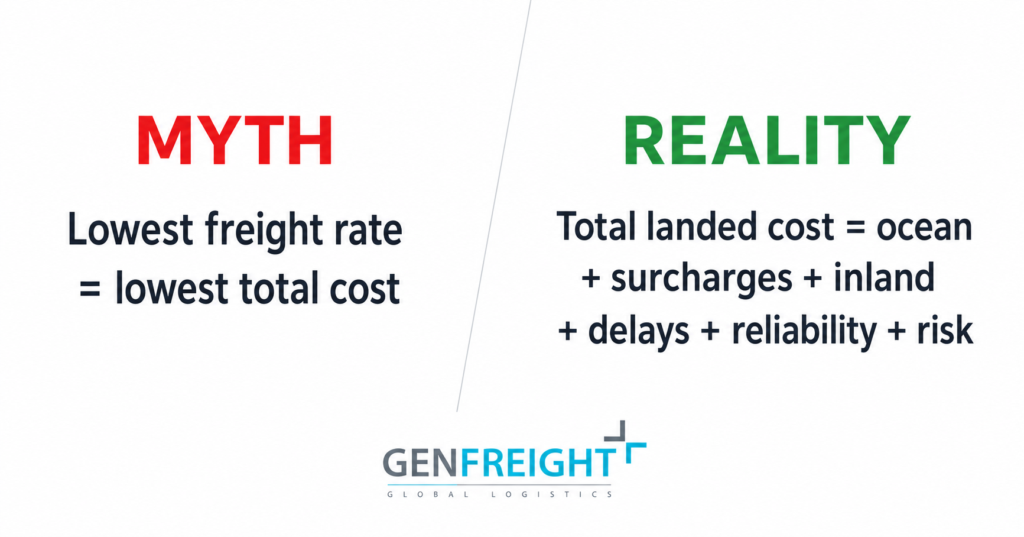
✖️ 𝗠𝘆𝘁𝗵 𝗕𝘂𝘀𝘁𝗲𝗱 – 𝙇𝙤𝙬𝙚𝙨𝙩 𝙛𝙧𝙚𝙞𝙜𝙝𝙩 𝙧𝙖𝙩𝙚 = 𝙡𝙤𝙬𝙚𝙨𝙩 𝙩𝙤𝙩𝙖𝙡 𝙘𝙤𝙨𝙩 ✖️
If your main question is “What’s the cheapest freight rate?”, you’re probably overpaying in 2026.
Freight rates are only one line in a much bigger equation.
For an Australian importer, the real cost of moving cargo from supplier to warehouse is made up of:
1. Ocean freight (base rate)
2. Surcharges (BAF/FAF, PSS, peak season, war risk, etc.)
3. Origin charges (terminal handling, documentation, export clearance)
4. Destination charges (THC, wharf, agency fees, customs, biosecurity)
5. Inland transport (port to warehouse, including fuel and accessorial fees)
6. Delays and disruptions (demurrage, detention, storage, missed sales)
7. Reliability (schedule integrity, roll risk, equipment availability)
8. Working capital (longer transit = cash tied up longer)
9. Risk (damage, compliance issues, incorrect INCOTERMS)
A slightly higher ocean rate can easily be cheaper overall if it delivers:
• Better schedule reliability
• Lower risk of rolls and transhipment delays
• More predictable inland costs and fewer surprises on the final invoice.
In 2026, global shipping is:
• Highly volatile, with rates moving week to week
• Capacity-managed via blank sailings and schedule adjustments
• Affected by geopolitical risks (e.g., Middle East, canal constraints) that change routings and transit times.
That means:
• The lowest quoted rate may come with longer transits, extra transhipments, or weaker service reliability.
• A “cheap” rate can hide high destination charges, poor equipment availability, or higher roll risk at key ports.
• For time-sensitive cargo, a single missed connection can cost more in demurrage, detention, and lost sales than the ocean freight “saving” ever delivered.
How do you compare quotes properly?
1. Ask for all-in, door-to-door scenarios
• Same INCOTERMS, same cargo specs, same target delivery window.
• Request a breakdown of origin, ocean, destination, and inland. Make sure you are comparing apples with apples.
2. Compare transit time and reliability, not just price
• Direct vs transhipped
• Historical on-time performance for that carrier/lane
• Risk of rolls or blank sailings on your preferred service.
3. Model the cost of delay
• What does one extra week in transit cost you in working capital?
• What’s the impact if the container is rolled or delayed at transhipment?
• How much would demurrage/detention cost if your warehouse can’t clear in time?
4. Look at total landed cost per unit
• Total cost ÷ number of units shipped
• This often flips the “cheapest” option completely.
5. Factor in relationship and problem-solving
• When things go wrong (and they will), how quickly does your forwarder respond?
• Do they proactively rebook, re-route, and communicate, or just forward carrier emails?
The best freight option is the one that gives you the most predictable total landed cost and delivery date, not the lowest ocean rate.