
Fuel Security for Freight Continuity
Fuel security is often discussed as an energy issue, but for freight and logistics businesses it is really a network resilience issue. Diesel, jet fuel, and refined petroleum products sit behind nearly every critical freight movement in the country, from linehaul and port haulage to warehousing, aviation, agriculture, and emergency response.
What has changed in recent weeks is not simply concern about fuel availability, but concern about how efficiently fuel can be distributed when the system is under pressure. Even where national supply remains intact, localized disruptions can still create serious operational consequences for regional transport operators, importers, exporters, and industries that rely on predictable replenishment cycles.
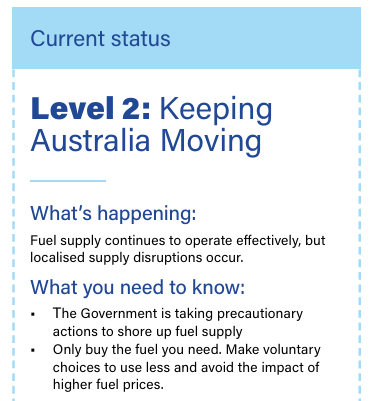
In response, National Cabinet agreed a National Fuel Security Plan on 30 March 2026, setting out a four-level framework for managing fuel supply stress across the country. Australia is currently operating at Level 2, “Keeping Australia Moving,” which means fuel is still flowing but the system is facing enough pressure to justify active monitoring, intervention, and coordination between governments and industry.
The short-term measures are important. The Commonwealth has moved to strengthen powers to underwrite additional fuel cargoes, support strategic reserves, and work more closely with suppliers and distributors to gather national-level supply-chain information. Other measures announced across the response include support for moving more fuel through the system, temporary steps to ease supply constraints, and a Fuel Supply Taskforce intended to improve visibility and decision-making as conditions evolve.
But the bigger story is structural. Australia imports the vast majority of its refined fuel from the Asia-Pacific region, while domestic refining capacity has declined to the point where local production covers less than 20% of demand. That means resilience depends not only on whether international cargoes can be secured, but on whether Australia has enough terminal capacity, transport flexibility, storage distribution, and coastal shipping capability to move fuel quickly to where it is needed.
This is why the maritime sector has become more vocal. The Maritime Union and other industry voices have argued that the recent disruption has exposed a sovereignty gap in Australia’s supply chains, particularly the country’s limited control over coastal fuel movements and its dependence on offshore commercial decisions. Their call for coordinated action includes mapping petroleum supply-chain vulnerabilities, strengthening strategic fleet capability, and rebuilding Australian-flagged tanker capacity so critical product can be moved in the national interest during a crisis.
For the logistics sector, the practical takeaway is clear: resilience is no longer just about inventory on hand, but about continuity of movement. A supply chain can appear secure on paper while still being vulnerable at the exact points that matter most operationally, berth access, storage location, truck availability, rail interface, regional replenishment, and emergency prioritization.
That is why this conversation matters beyond fuel retailers or policymakers. Freight operators, importers, exporters, ports, and transport providers all have a stake in how Australia redesigns its approach to fuel resilience. The issue touches every part of the logistics chain: how freight keeps moving, how regional communities are supplied, how essential services are protected, and how quickly the country can respond when global shocks interrupt normal trade patterns.
In that sense, the current moment may prove useful. It has pushed fuel security out of a narrow policy box and into the mainstream logistics conversation, where it arguably belongs. The next step will be whether Australia converts this response into longer-term capability, better distribution planning, more redundancy in infrastructure, improved visibility, and stronger sovereign shipping options, rather than treating it as a temporary disruption.