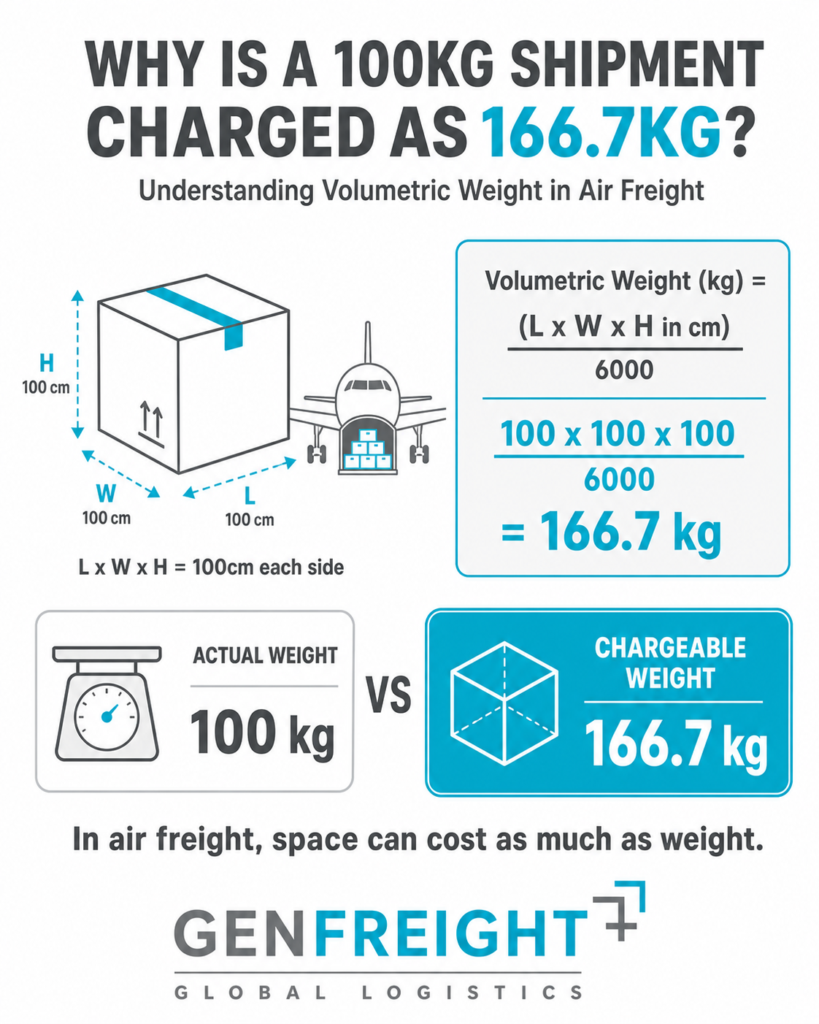
“My shipment only weighs 100kg. Why am I being charged for 166.7kg?”
It sounds like an error, but it isn’t. It comes down to one simple industry rule that every shipper, exporter and freight buyer should understand before they book an air shipment.
Airlines and freight forwarders bill on whichever is greater: the shipment’s actual (gross) weight, or its volumetric weight. This is a global standard set by International Air Transport Association (IATA) in its TACT Rules, and every major carrier and forwarder applies it the same way.
The volumetric weight formula is:
Volumetric Weight (kg) = (Length × Width × Height, in cm) ÷ 6,000
The “6,000” divisor isn’t arbitrary. It reflects an assumed cargo density of 167kg per cbm. Anything lighter than that density, relative to its size, gets charged on volume instead of scale weight, because it’s taking up aircraft space that could otherwise carry heavier cargo.
Worked Example
Say you have a carton measuring 100cm × 100cm × 100cm, weighing 100kg on the scale.
Volumetric Weight = (100 × 100 × 100) ÷ 6,000 = 166.7kg
Even though the actual weight is only 100kg, the carrier compares that to the 166.7kg volumetric figure and charges the higher number. Your cargo weighs 100kg, but it occupies the space of 166.7kg, and on an aircraft, space is every bit as valuable as weight.
Three details catch shippers out more than anything else…
1. Multi-piece shipments: the volumetric weight must be calculated per piece, then summed, before comparing the total against the total actual weight. You can’t average dimensions across a mixed shipment.
2. Divisor varies by service type: general air cargo uses a divisor of 6,000, but express couriers often use a tighter divisor of 5,000. That same 100 x 100 x 100cm box would be charged at 200kg on an express courier service instead of 166.7kg on standard air cargo. This is a big reason why quotes for the “same” box can look very different depending on which service you book.
3. Carriers also measure dimensions at the outermost points of a shipment, including pallet feet, tape bulges and protruding handles or straps, so even small packaging inefficiencies can push a shipment over a chargeable weight breakpoint.
In air freight, space can cost as much as weight. Reducing dead-air space, choosing lower-profile pallets, tightening carton dimensions and consolidating pieces where possible can meaningfully lower your chargeable weight, and therefore your freight cost, without changing what you’re actually shipping.
For light-but-bulky cargo (think apparel, textiles, foam-packed electronics or agricultural products), volumetric weight is very often the number that determines your invoice, not the number on the scale. Understanding this upfront, before you pack and quote a shipment, is one of the simplest ways to avoid unwelcome surprises on your freight bill.