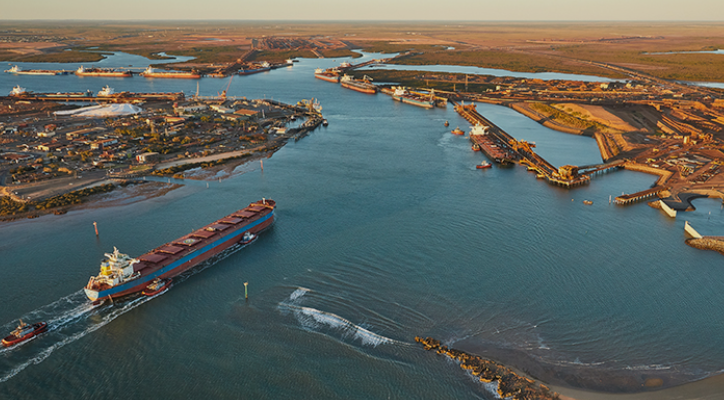
Australia’s iron‑ore corridor is being flagged as one of the most advanced green shipping routes in the world, with Pilbara Ports at the centre of that push.
According to Jesse Fahnestock, decarbonisation director at the Global Maritime Forum (GMF), the Pilbara is “furthest ahead amongst the big routes where large vessels are trafficking”, a strong endorsement for a region already handling some of the world’s highest bulk shipping volumes.
Why Pilbara? GMF highlights several structural advantages that put Pilbara Ports in a leadership position.
1. High‑volume, predictable trade lane – The iron‑ore corridor offers consistent, large‑scale vessel movements, making it an ideal testbed for new fuels and operational changes.
2. Proximity to clean‑fuel production – Existing ammonia plants (e.g. Yara Pilbara) and emerging hydrogen/ammonia projects mean fuel can be produced close to where it’s bunkered.
3. Shorter transits to key Asian markets – Compared with many global corridors, distances to major Asian import hubs are relatively short, reducing the initial complexity of switching to new fuels.
Fahnestock notes that Pilbara Ports has “really embraced their role… they see their role in this as an enabler”, pointing to ammonia‑bunkering simulations and upcoming trials as evidence of credible, on‑the‑ground progress.
Pilbara Ports have moved beyond concept studies into concrete planning.
They have released a Clean Fuel Bunkering Hub strategic roadmap (check it out here), targeting low‑carbon ammonia and other alternative marine fuels.
The Pilbara story sits inside a broader national shift. In late August 2026, the Australian Government released the Maritime Emissions Reduction National Action Plan (MERNAP), setting out seven priorities across energy, ports, shipping, domestic vessels, and skills.
Key elements relevant to Pilbara and other major ports include:
~ Investment in port infrastructure and operations that accelerate decarbonisation (e.g. fuel storage, bunkering, shore power).
~ Support for green shipping corridors, including digital and operational measures like just‑in‑time arrivals and a Maritime Single Window to cut waiting time and fuel burn.
~ Funding programs that can back clean‑fuel projects, such as the $1.1 billion Cleaner Fuels Program, the Green Fuel Bunkering Strategy, and targeted initiatives with Singapore and South Korea.
Pilbara Ports’ positioning is a practical indicator of where shipping’s energy transition will play out first in Australia, but urgent action is needed to capitalise on it. Let’s hope others watch and follow suit.
📸 and reference DCN and GMF