🏗️ 𝗖𝗮𝗿𝗿𝗶𝗲𝗿𝘀 𝗔𝗿𝗲 𝗕𝘂𝘆𝗶𝗻𝗴 𝗣𝗼𝗿𝘁𝘀. 𝗪𝗵𝗮𝘁 𝗗𝗼𝗲𝘀 𝗜𝘁 𝗠𝗲𝗮𝗻? 🏗️
Container shipping lines are no longer content simply to charter vessels and call at ports. They are increasingly buying into the terminals, inland connections and infrastructure that determine whether cargo actually moves reliably.
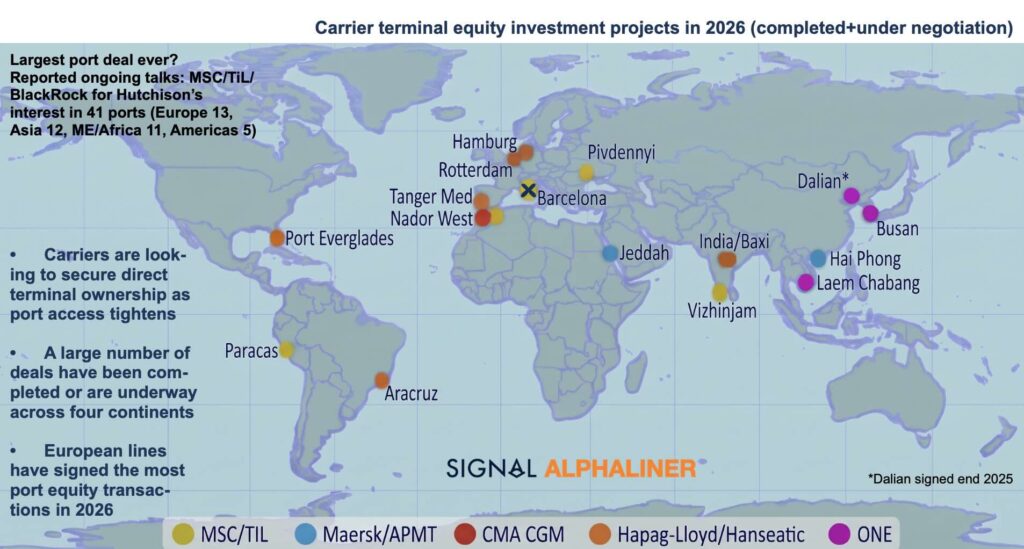
Recent reporting by Splash247 highlights an accelerating global “port buying spree”, with major lines including MSC Mediterranean Shipping Company, A.P. Moller – Maersk, CMA CGM, Hapag-Lloyd AG, Ocean Network Express and COSCO SHIPPING expanding their interests in terminal assets across Asia, Europe, the Americas, Africa and the Middle East.
This is a signal about how the next decade of supply-chain competition will be won, not only by vessel capacity, but by control of the critical nodes where containers are handled, stored, railed and dispatched.
Terminal ownership or long-term participation gives carriers greater influence over these variables. It also supports network resilience, particularly important as geopolitical disruption, Red Sea rerouting, port congestion and changing trade patterns continue to test global schedules.
CMA CGM has explicitly linked its terminal strategy to securing operations, strengthening trade corridors and improving reliability for customers.
CMA CGM and infrastructure investor Stonepeak completed the formation of United Ports in July 2026, combining nine major CMA CGM-operated terminals across the United States, Brazil, Spain, Taiwan and Vietnam. Stonepeak invested US$2.4 billion for a 25% stake, while CMA CGM retained 75% ownership and operational control.
The partnership is intended to fund terminal expansion, new handling equipment, rail and inland connectivity, equipment electrification and shore power.
Meanwhile, Hapag-Lloyd has acquired a 25% stake in APM Terminals Maasvlakte II in Rotterdam, strengthening its position in one of Europe’s key hubs. MSC’s Terminal Investment Limited has also expanded its footprint through transactions in Peru, Morocco and Ukraine.
Australia may be geographically distant from many of these transactions, but the underlying issue is that port and terminal capacity directly affects importers, exporters, transport operators and ultimately the cost and reliability of goods moving through our supply chains.
The global port investment wave suggests that leading carriers see infrastructure as a strategic asset, not merely a cost centre. They are building integrated networks that combine vessels, terminals, inland transport and logistics services.
For Australia, the challenge is to ensure that port capacity, intermodal infrastructure and landside planning keep pace with trade growth. Otherwise, global carriers may become increasingly capable of controlling the maritime network closer to home.
📸 and reference https://splash247.com/containerlines-accelerate-global-port-buying-spree/