
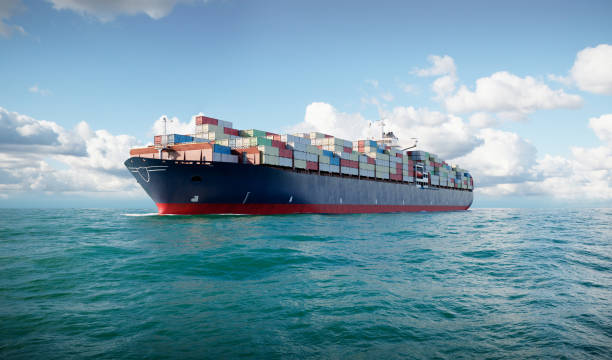
Cargo ships are the backbone of global trade, carrying nearly 90% of the world’s goods. These vessels come in a wide variety of shapes and sizes, each specifically designed to transport a particular type of cargo efficiently. Understanding the different types is key to appreciating the complexity of modern logistics.
Container Ships
Container ships are arguably the most recognizable and dominant type of cargo vessel today.
- Cargo: Standardized ISO containers (TEU – Twenty-foot Equivalent Unit, and FEU – Forty-foot Equivalent Unit).
- Design: Characterized by a long, flat deck and a series of guide rails (cell guides) in the holds to stack containers both below and above deck.
- Key Feature: Their reliance on standardized containers revolutionized shipping, allowing for intermodal transport (easy transfer between ship, train, and truck). They are typically the largest and fastest cargo vessels.
- Example: Ultra Large Container Vessels (ULCVs) can carry over 24,000 TEUs.
Bulk Carriers
Bulk carriers (or bulkers) are designed to transport unpackaged, loose cargo (dry bulk) in massive, open holds.
- Cargo: Commodities like ore, coal, grain, cement, and fertilizer.
- Design: Feature a distinctive line of large, box-like hatches along the deck, opening into vast cargo holds. They often use their own cranes (geared bulkers) for loading and unloading in ports without shore-side equipment.
- Key Feature: They are categorized by size, from Handysize to Capesize, with the latter being too large to pass through the Panama or Suez Canals fully loaded, hence the name “Capesize” (requiring them to travel around the Cape of Good Hope or Cape Horn).
MS Ore Brasil is currently the largest of its kind, with a capacity of over 400,000 DWT (Deadweight Tonnage).
Tankers
Tankers are specialized ships built to carry liquid cargo in large tanks.
- Cargo: Includes crude oil, petroleum products (gasoline, diesel), liquefied natural gas (LNG), chemicals, and edible oils.
- Design: Characterized by their smooth decks with complex networks of pipes and pumps for loading and discharging the liquid cargo. They are double-hulled for environmental safety.
- Key Categories:
- Oil Tankers: Range from small coastal vessels to Very Large Crude Carriers (VLCCs) and Ultra Large Crude Carriers (ULCCs). The longest self-propelled ship ever built was an oil tanker, the TT Seawise Giant, at 458.45 metres.
- Chemical Tankers: Carry specialized chemicals and often have stainless steel tanks for purity.
- LNG/LPG Carriers: Use specialized, insulated tanks (often spherical, or membrane-type) to keep gas liquefied at very low temperatures.
Roll-on/Roll-off (Ro-Ro) Ships
Ro-Ro vessels are designed to carry wheeled cargo, allowing it to be driven directly on and off the ship.
The largest car carrier (PCTC) in the world by capacity is the MV Hoegh Aurora, designed to carry up to 9,100 car equivalent units.
- Cargo: Primarily cars, trucks, construction equipment, and railway rolling stock.
- Design: They have multiple internal decks and feature built-in ramps (stern, bow, or side) that facilitate the rapid loading and unloading of vehicles.
- Key Feature: Highly efficient for vehicle transport, eliminating the need for cranes. Pure Car and Truck Carriers (PCTCs) are a common subtype.
Refrigerated Cargo Ships (Reefers)
Reefers are essentially floating, mobile freezers or refrigerators, designed to transport perishable goods under temperature-controlled conditions.
The first successful international shipment of frozen meat from New Zealand to the UK in 1882, on the vessel reefer vessel Dunedin.
- Cargo: Fruits, vegetables, meat, fish, dairy products, and pharmaceuticals.
- Design: Their holds are highly insulated and equipped with powerful refrigeration units capable of maintaining precise temperatures, ranging from chilling to deep-freezing. They often carry refrigerated (reefer) containers on deck as well.
The modern cargo fleet represents a highly sophisticated and specialized system, ensuring that raw materials and finished products reach virtually every corner of the globe. This specialization is what enables the massive scale and low cost of today’s international trade.