
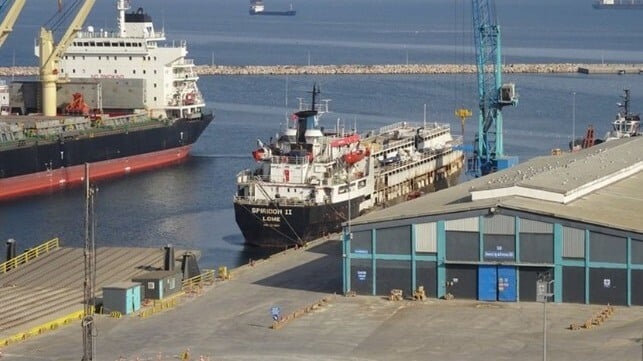
The 24-day standoff involving the livestock carrier Spiridon II off the coast of Turkey has been resolved. The outcome, however, represents a catastrophic operational and financial failure for all stakeholders.
The vessel has been officially rejected by Turkish authorities and is now beginning the long voyage back to its port of origin in Montevideo, Uruguay, which is 10,000nm away.
After arriving in late October, the vessel was held at anchorage. A court-ordered inspection confirmed “documentation and health-record irregularities”. Reports indicate nearly 500 cattle ear tags did not match the manifest.
The ship was denied unloading, only briefly allowed to berth on Nov 9th to take on emergency fodder and water before being ordered back to sea.
This event is a perfect storm where data integrity, biosecurity, maritime law, and asset risk have all failed simultaneously.
1. The Biosecurity Failure: “Why the Ear Tags Matter”
This wasn’t a simple “typo” or clerical error; it was a fundamental breach of the importing country’s biosecurity.
- Traceability is Everything: For a nation’s agricultural sector, an ear tag is the entire basis of traceability. It’s the link to an animal’s health certificate, vaccination history, and place of birth.
- A “Ghost” Animal: An animal with a mismatched or missing tag is a “ghost.” Turkish authorities have no way of knowing if that animal is from a region with Foot-and-Mouth Disease (FMD), if it has been properly vaccinated, or if it was substituted post-inspection.
- The Precautionary Principle: From a biosecurity perspective (which you’ll know well from Australian DAFF rules), you cannot just reject the 500 “bad” animals. Because all 2,900+ cattle have been co-mingled in shared pens for over a month, the entire consignment is considered compromised. The risk of one animal introducing a catastrophic disease to the Turkish herd means the entire shipment must be rejected.
2. The Financial & Logistical Implosion: “A Total Loss”
For the exporter, this is a catastrophic financial loss far beyond the value of the animals.
- Sunk Cargo Cost: The value of nearly 3,000 cattle is now effectively zero.
- Double Freight: The exporter is now paying for a two-way vessel charter. They paid for the 30+ day voyage from Uruguay to Turkey, and now they are paying for the 30+ day return voyage. This includes fuel, crew wages, and vessel hire for over two months.
- Ancillary Costs: They had to pay for the emergency fodder, water, and port fees in Bandırma just to be allowed to leave.
- Cargo Disposal: The animals cannot simply be re-integrated into the Uruguayan herd. Having been to a foreign (and now suspect) jurisdiction, they will have to be quarantined and will almost certainly be slaughtered and disposed of at the exporter’s expense.
3. The Regulatory “Black Hole”: “No Port to Run To”
This is the most critical point from a maritime law perspective. Once the Spiridon II was rejected by Turkey, it had nowhere else to go.
- Blacklisted Cargo: No other port in the region (Greece, Italy, Egypt) will accept a live cargo that has been officially rejected by another major port state for biosecurity reasons. To do so would be to knowingly import Turkey’s biosecurity risk.
- Jurisdictional Void: The vessel is trapped.
- Turkey (Port State): Has the sovereign right to refuse entry.
- Togo (Flag State): Is a “flag of convenience” with no diplomatic power to force entry.
- Uruguay (Exporter State): Has no legal jurisdiction in the Mediterranean.
- A Repeat of 2021: This is an exact repeat of the Karim Allah and Elbeik incidents, where two vessels were stranded for months under similar circumstances, resulting in the eventual death or euthanasia of their entire cargo. The law has not evolved to solve this problem.
4. The Asset Risk: “The Ship Itself”
The vessel itself is a major part of the risk profile.
- Age: The Spiridon II is 52 years old (built in 1973). It was converted from a general cargo ship, not purpose-built.
- Flag & History: It sails under the flag of Togo, which is on the Paris MOU “black list” for poor inspection records. This specific vessel is known to have suffered an engine failure off the coast of Spain in 2022, also while fully loaded with livestock.
The exporter chose to put a high-value, high-risk cargo on an aging, low-cost asset with a known history of mechanical failure, which has now been caught in a bureaucratic-biosecurity trap. The result is the worst possible outcome for the animals and a total financial loss for the exporter.
📸 Animal Welfare Foundation