

What is a Customs Broker? The Simple Answer
So, what exactly is a customs broker in Australia? To put it simply, they are your licensed expert in the complex world of international trade. A customs broker acts as a crucial liaison between your business and powerful government agencies, including the Australian Border Force (ABF) and the Department of Agriculture, Fisheries and Forestry (DAFF). They handle the heavy lifting of customs clearance on your behalf, allowing you to focus on running your business.
It’s important to understand that not just anyone can be a customs broker. In Australia, all customs brokers must be licensed by the Department of Home Affairs. This strict licensing process isn’t just about professional standards. It’s a measure designed to protect both the Commonwealth Revenue and the broader Australian community. This ensures every declaration is accurate, every duty is paid, and all goods entering the country are safe and compliant.
Think of a customs broker as your tax accountant for international shipments. You wouldn’t tackle your business taxes without an expert, right? Similarly, you shouldn’t handle complex customs declarations without a licensed professional.
Their core responsibilities include:
- Firstly, preparing and lodging all necessary customs declarations.
- Secondly, classifying your goods with the correct tariff code, which directly impacts the duties and taxes you pay.
- Thirdly, accurately calculating and paying duties, taxes, and other government charges.
- Finally, advising you on compliance and import regulations to prevent costly errors.
The Day-to-Day Role of a Customs Broker: A Deeper Dive
Now that we understand what a customs broker does, let’s delve into the specifics of their day-to-day role of a customs broker. And, how their expertise directly benefits your business. Generally their work goes far beyond simply filling out forms. Additionally, it’s a strategic process that ensures your goods navigate the global supply chain seamlessly.
Handling the Paperwork & Declarations
The first and most visible part of a customs broker’s job is managing the documentation. Every import and export requires a mountain of paperwork, from commercial invoices and packing lists to bills of lading and certificates of origin. The customs broker’s job is to prepare and lodge all these declarations on your behalf. Moreover, they ensure every detail is accurate and that submissions are made on time. For a detailed breakdown of these critical documents, you can check out our article on What are the custom clearance documents for Import and Export .
Goods Classification: The Tariff Code is Key
Every single item that crosses the border has a specific tariff code. Furthermore, this numerical classification determines the amount of duty and tax you will pay. An incorrect classification can lead to two equally bad outcomes. On one hand, you might overpay duty and cut into your profits, while on the other, you could underpay and face significant penalties from the Australian Border Force. So a skilled customs broker ensures your goods are classified correctly, saving you money and preventing potential legal issues.
Calculating Duties and Taxes
Beyond the basic tariff code, a customs broker’s expertise is crucial for accurately calculating the customs value, duty, and GST on your goods. Furthermore, they are experts in a range of legal ways to reduce these costs. This includes leveraging Free Trade Agreements (FTAs), which can significantly lower or even eliminate duties on goods from certain countries. As a result, their knowledge here can lead to substantial savings for your business.
Ensuring Compliance with Ever-Changing Regulations
This is arguably the most crucial part of their job. The world of import and export regulations is in a constant state of flux. So, a customs broker’s responsibility is to stay up-to-date with these ever-changing laws, ensuring your shipment meets all biosecurity, safety, and trade regulations. And a key part of their mandate is to protect the Australian community by preventing the import of dangerous or prohibited goods. A timely example of this is the recent ban on the importation of engineered stone. Without expert advice, a business could unknowingly import a now-prohibited item, leading to a total loss of the goods.
Troubleshooting and Problem-Solving
Finally, if something goes wrong—a shipment is held for inspection, a documentation error is flagged, or an issue arises with a government agency—the customs broker becomes your first point of contact. Moreover, they work quickly to resolve problems and keep your goods moving. In other words, they act as the expert who communicates with the ABF and other departments on your behalf. Also they work quickly and efficiently to resolve the problem and get your goods moving again.
The Big Picture: Customs Broker vs. Freight Forwarder vs. Logistics Provider
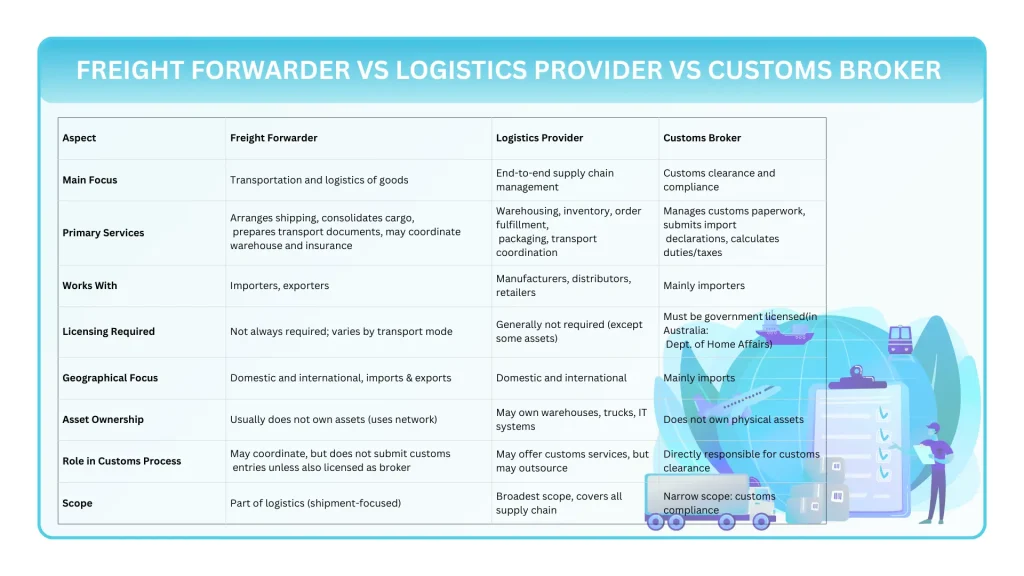
Understanding the role of a customs broker is key, but it’s equally important to see where they fit within the entire supply chain. While these terms are often used interchangeably, they represent distinct functions that work together to move your goods around the world. Let’s use a simple metaphor to explain the differences:
- The freight forwarder is the “travel agent” for your cargo. They book the flights or sea voyages, arrange the itinerary, and make sure your goods get from one country to another. In other words, they are the transportation experts.
- The customs broker is the “visa officer.” So, their job is to ensure your cargo has all the correct paperwork and permissions. Consequently, this guarantees your goods can legally enter or exit the destination country without unnecessary delays. They are the compliance and declaration experts.
- The logistics provider is the “full-service concierge.” This is the broadest term, overseeing the entire journey from start to finish, including pickup, warehousing, transport, and customs clearance.
A quick breakdown of their roles:
- Customs Broker: Firstly, their expertise is laser-focused on the single, critical step of customs clearance. Overall, they are the professionals who handle the legal and administrative side of international trade.
- Freight Forwarder: These are the transportation specialists. So they arrange the physical movement of your goods, booking space on shipping lines, air cargo, or trucks. It’s worth noting that many modern freight forwarders, like GenFreight Global Logistics, also offer in-house customs brokerage as part of their comprehensive service, providing a seamless, one-stop solution.
- Logistics Provider: This is an umbrella term that can encompass both freight forwarding and customs brokerage. Moreover, it includes a range of other services such as warehousing, order fulfilment, and distribution.
In short, a customs broker handles the “paper journey,” while a freight forwarder handles the “physical journey.” A good logistics provider often manages both, creating a single, integrated service for your business.
The Value Proposition: Why a Broker is Worth the Cost
While there is a customs broker cost, the value they provide almost always far outweighs it. For example, a single mistake in your documentation or classification can lead to a range of expensive problems, including:
- Financial Penalties: Firstly, fines from the ABF for non-compliance.
- Delays: Secondly, your goods being held at the border, incurring storage fees and disrupting your supply chain.
- Lost Revenue: Thirdly, your products not reaching the market on time.
Overall, the right customs broker will help you avoid these mistakes, and they can often find legal ways to reduce your costs through Free Trade Agreements. The best choice is not necessarily the cheapest, but the one that offers a good balance between competitive pricing and high-quality services that align with your specific requirements.
To help you find a broker who provides this kind of value, we’ve put together a list of resources. You can read more in our article Top Customs Clearance Brokers in Australia .
How to Choose the Right Customs Broker for Your Business
Now that you know the vital role a customs broker plays, the next logical step is to find the right one for your business. Choosing a partner who truly understands your needs is crucial, and it’s a decision that can save you significant time, money, and stress in the long run. Here are some actionable steps to guide your choice.
1. Check for Licensing
First and foremost, always ensure that your broker is a licensed professional. In Australia, this means they must be licensed and registered with the Department of Home Affairs. This licensing process is rigorous and, therefore, ensures the individual has the necessary knowledge and experience. As a result, they can handle your declarations correctly and responsibly. Consequently, this provides a crucial layer of trust and accountability.
2. Look for Specialisation
Furthermore, it’s highly beneficial to find a broker with specific expertise. Do they have experience working with your type of goods, for example, perishable food, electronics, or machinery? Do they have a proven track record of handling imports or exports to your target markets? A broker who understands the unique challenges and regulations of your specific industry can help you avoid common pitfalls and find efficiencies that a generalist might miss.
3. Ask for References & Check Memberships
Moreover, to verify a broker’s credibility, don’t be afraid to ask for references from their previous clients. Speaking with other businesses they’ve worked with can provide valuable insights into their reliability and quality of service. Additionally, check if they are a member of an industry association, such as the International Forwarders & Customs Brokers Association of Australia (IFCBAA). Membership in such an organisation demonstrates a commitment to professional development and industry standards.
4. Get a Detailed Quote
Finally, when you’re ready to get a quote, ask for a clear and detailed breakdown of all potential fees. This should include their professional fees for customs clearance and document preparation, as well as any other charges. Undoebtedly, a transparent quote promotes trust and allows you to effectively compare different providers. Remember the golden rule: the cheapest option isn’t always the best. A broker’s value lies in their ability to protect you from costly mistakes and ensure a smooth, compliant trade process.
Conclusion
In summary, a customs broker is much more than just a paperwork handler, they are a licensed expert and a vital partner for any business engaged in international trade. Their deep knowledge of ever-changing regulations ensures your goods comply with all Australian laws, saving you time, money, and the considerable stress of navigating the customs process alone. Ultimately, they are a safeguard against costly mistakes and a key to ensuring a smooth, efficient supply chain.
If you’re looking to simplify your import and export journey, we invite you to speak with the logistics providers at GenFreight Global Logistics. Our team can handle the entire process under one roof – from transport and documentation to expert customs clearance. We’ll guide you through making an informed decision, providing a complete logistics solution tailored to your unique business needs.